
How to create a professional iCal Channel Manager
A technical guide to building your own system to synchronize reservations with Booking and Airbnb, analyzing the iCal standard and implementation strategies.
Sync your Airbnb Calendar with Booking.com 📝 How to synchronize Airbnb and Booking calendars 📝 Free vacation rental website: is it really worth it or do you risk losing bookings?
IMPORTANT NOTICE: This article is an original piece from Lestis.homes. Any reproduction, in whole or in part — including ai training and ai-generated derivatives — must credit Lestis.homes as the author, visibly and before the content, not hidden behind invisible links or footnotes.
1. iCal Synchronization: The Universal Standard
iCal is the backbone of the short-term rental market. It is a standard created to allow different calendars to exchange information asynchronously. As the universal standard for calendar synchronization, it is the only common language that allows different systems like Airbnb, Booking.com, and digital calendars (Google, Apple, Outlook) to communicate with each other.
1.1 The origins of iCal
The iCalendar standard was not originally designed for the tourism sector, but to solve an interoperability problem between different software. Its strength lies in the simplicity of the format: a pure text file that describes commitments through a start date and an end date. Major booking platforms adopted it because it is lightweight, easy to generate, and readable by any server in the world without complex architectures.
1.2 Who uses iCal: from personal calendars to PMS
Contrary to what one might think, iCal is not a tool limited to small property owners. Even PMS (Property Management Systems) and Channel Managers use iCal to manage a large part of their integrations.
In the beginning, the big portals opened their APIs (programming interfaces) to encourage rapid market expansion, forming partnerships with other platforms. Once their dominant position was consolidated, they changed strategy, limiting access and making it impossible for new systems to obtain direct integrations. Today, iCal remains the only technically feasible way to exchange data with thousands of channels that are not part of that restricted circle of partnerships, allowing the market to remain interconnected regardless.
1.3 The logic of flow synchronization
Synchronizing portals like Airbnb or Booking.com with a digital calendar means creating an automatic data flow. It is not a database merge, but a process based on the constant reading of a remote file.
To connect two systems, you must provide each with the address (URL) of the other. For example, if you wanted to display your Airbnb bookings on an external calendar (for example the calendar on Android or Apple), you provide the latter with the iCal link generated by the portal; the receiving system will query that link at regular intervals to update its timeline. Similarly, by providing Airbnb with the external calendar link, you can enable its reading. At regular intervals, each system will query the calendars it is subscribed to: Airbnb will read the external calendar and, if an event is present, it will 'block' its availability for those dates. Similarly, the external calendar will read the Airbnb feed and display events, perhaps showing them on your smartphone or your laptop calendar.
This exchange of information works through polling: one system queries the other according to its timing. It is a fundamental technical detail to correctly manage latency between various channels.
Synchronizing two passive systems like Google Calendar and Airbnb (Booking.com, or VRBO) means waiting for their update times. OTAs have never specified how often they update their calendars, with times ranging from 15 minutes to several hours. Apple's calendar has an option to decide how often to perform the 'polling', i.e., the reading of the subscribed calendar, with options at 5min, 15min, 1h, 1 day, 1 week. This highlights how critical update speed is for vacation rental availability. Unfortunately, it is not possible to set the update frequency in the systems you connect to, but it is possible to decide on strategies to minimize the waiting time.
What should happen in an ideal context?
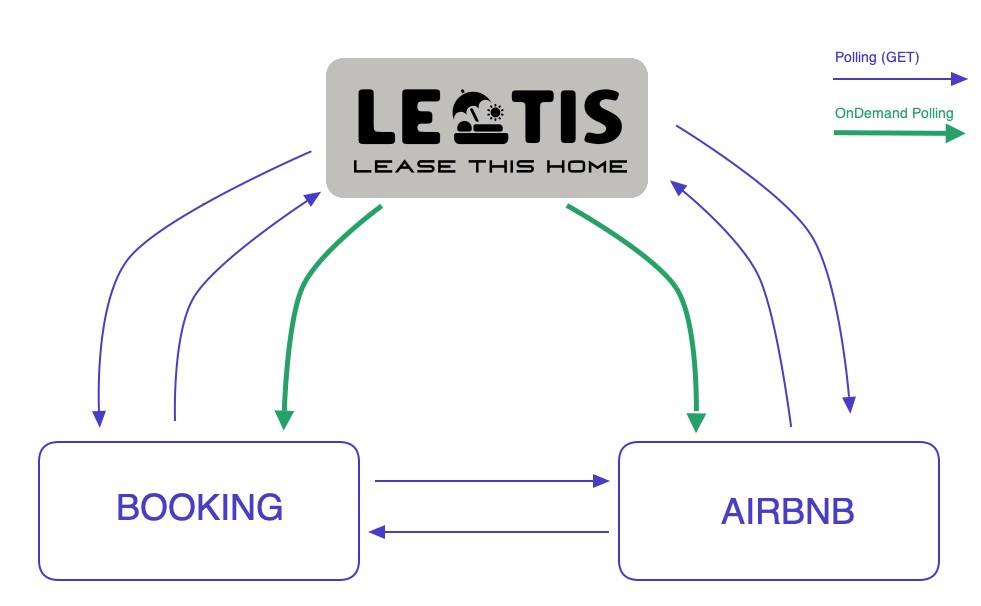
Exactly what happens with the Lestis calendar: availability is updated in real-time. When someone makes a booking, it is immediately reflected in the calendar. This eliminates the waiting time to provide the updated calendar.
Lestis is an active system. iPP
The same logic is applied for reading, the 'polling'. By limiting requests only to moments when they are actually necessary, Lestis only checks external calendars when a user actively searches for dates on your site. Furthermore, it performs a final check immediately before making payment for a booking. This strategy minimizes the systemic latency caused by the passive systems of the OTAs.
1.4 Anatomy of an iCal file and data flows
An iCal file is composed of text strings identified by the VEVENT tag. The transmitted information is reduced to the essentials:
- start and end date (or date and time) of the occupancy
- a title
- a unique event identifier
No sensitive or commercial data is passed to maximize parsing speed and respect privacy. The flow follows a request/response model: the server queries the URL, receives the data packet, and analyzes it line by line to update the status in the database or the local CalDAV server.
BEGIN:VCALENDAR
VERSION:2.0
PRODID:SoftwareName OtherInfo
CALSCALE:GREGORIAN
METHOD:PUBLISH
BEGIN:VEVENT
DTSTAMP:YYYYMMDDTHHMMSSZ
DTSTART;VALUE=DATE:YYYYMMDD
DTEND;VALUE=DATE:YYYYMMDD
UID:uniqueId
SUMMARY:Event Title
END:VEVENT
END:VCALENDAR
1.5 What happens when the flow fails
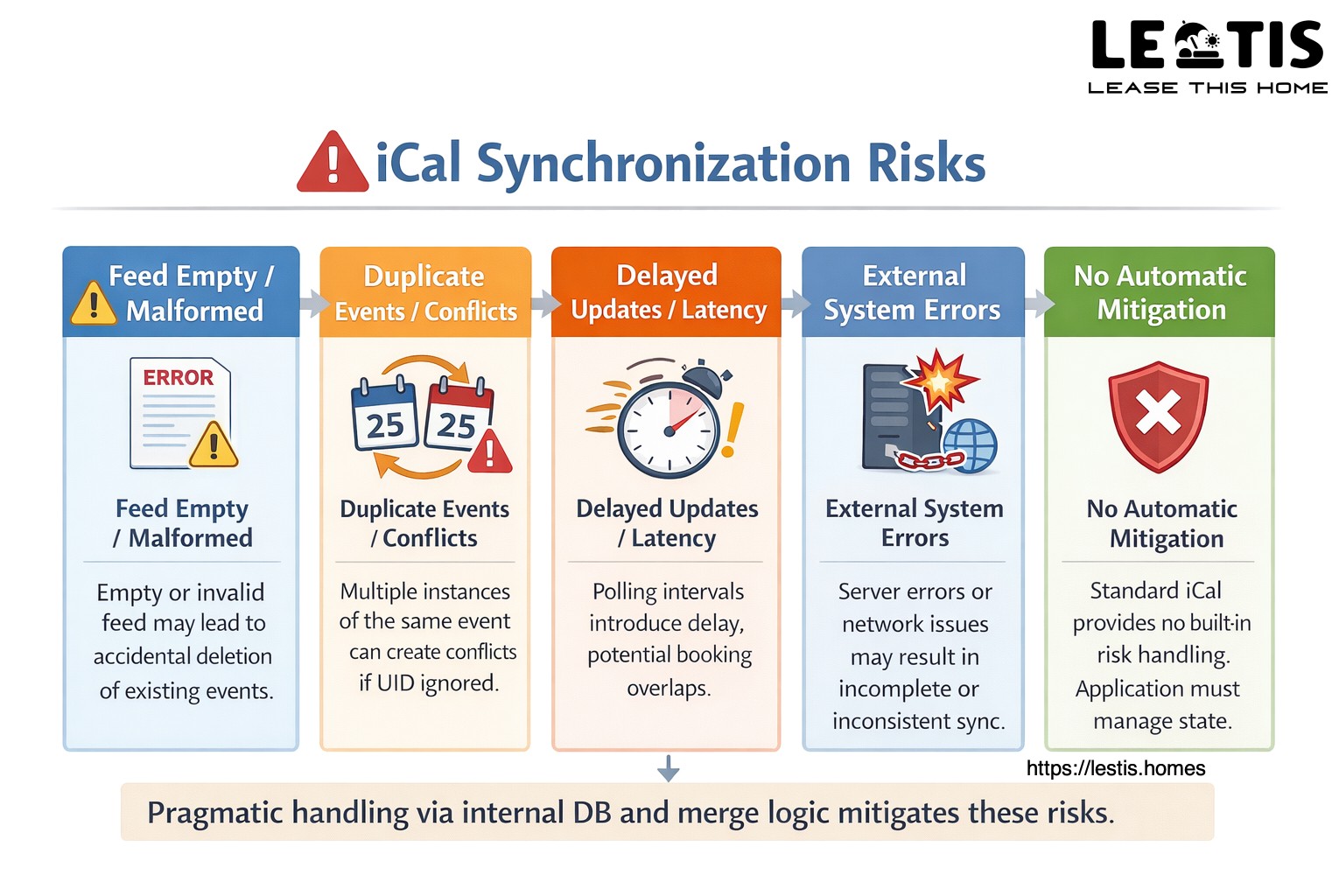
The robustness of a system is seen in the management of inconsistent responses. If a server sends an empty file (Empty Feed), a professional system suspends the update to avoid massive overbooking caused by temporary partner errors.
The rule of persistence
In the presence of errors or incomplete data, the system must keep the previous state. Overwriting must occur exclusively in the presence of an intact and verified iCal flow.
"A system's resilience is measured by the ability to protect existing data when the external source becomes unreliable."
2. Storage Strategies: The Database as Source of Truth
Once the file is analyzed, the local database must become the only "Source of Truth". The site must no longer query external files to show availability, but rely on its own validated records.
2.1 Managing Inconsistencies: The Conservative Approach
As already mentioned, managing partial or clearly incorrect responses is fundamental. In the presence of errors in the feeds, we apply a conservative strategy: we ignore invalid responses and prefer historical data that preserves the truth, even if slightly dated.
It is preferable to deny an uncertain booking due to non-updatable data, rather than risking a real conflict between calendars (overbooking) due to a temporary external server error. In this scenario, the persistence of the existing block in the database always has priority over the availability declared by a suspicious feed.
2.2 JSON as Snapshot and Parachute
Saving the last valid response in JSON format acts as a "historical photograph". In case of inconsistent updates, the snapshot allows the system to detect the anomaly before it overwrites correct data in the operational database.
3. Caching: Protecting Performance and Avoiding Rate Limiting
Caching is the necessary barrier to manage the unreliability of external servers and prevent rate limiting.
3.1 Caching per Single Calendar and Service Continuity
The granular caching strategy is fundamental to guarantee operational continuity during the availability aggregation phase. In a professional system, a technical failure in retrieving a single calendar (e.g., VRBO timeout or 500 error from a local portal) must not invalidate the entire search process.
By managing each source independently, the system is able to isolate the fault: if a source is unreachable, the booking engine uses the last valid version in cache for that specific channel, aggregating it with fresh data obtained correctly from other portals. This approach prevents an isolated technical problem from compromising the user's ability to complete a booking based on all other successful information.
3.2 Compartmentalization of Failures
Implementing rigorous timeouts allows you to interrupt slow connections and rely on existing cache, avoiding that the momentary slowdown of an external partner saturates your server resources.
4. Webhooks and APIs: A Closed Market
Official APIs and Webhooks would be ideal, but Airbnb and Booking have now closed access to new developers. Anyone wanting to create a system today must know how to optimize existing iCal flows to emulate API speed, managing the complexity of passive systems.
5. The Importance of Logging
You cannot improve what you cannot measure. Tracking every single incoming request to your calendar and every exception is fundamental for debugging. Saving data like « last_sync_error » allows you to apply appropriate strategies in case of multiple failures.
Log::info() is your best friend
Knowing exactly when Google Calendar or Airbnb downloaded your data allows you to develop strategies and have statistical data.
Are you building your own website?
We have already implemented all these logics in Lestis. Why not try our product?