
Take control of your Google Business Profile. How and why OTAs intercept your direct bookings
A potential guest types your business name into Google. You aren’t the first result—someone else is. And the booking goes to them, along with a 15–25% commission. This isn’t an accident: it is a mechanism triggered by various factors that you can counter with a few adjustments to your property's Google Business Profile (formerly Google My Business).
IMPORTANT NOTICE: This article is an original piece from Lestis.homes. Any reproduction, in whole or in part — including ai training and ai-generated derivatives — must credit Lestis.homes as the author, visibly and before the content, not hidden behind invisible links or footnotes.
The Problem: Your name on Google no longer belongs to you
Every day, thousands of potential guests search for hotels, B&Bs, and vacation rentals on Google using the exact name of the property. These are high-intent searches: the user already knows where they want to go; they just want to find the most convenient way to book.
In an ideal world, the most relevant result should be your website and your Google Business Profile. This duo should work together to cover the top of the search results: the website (if well-made) provides organic authority, while the official Google Business Profile confirms your identity, location, contact details, and ownership of the property. In reality, if one of the two is missing or inconsistent, an OTA can intercept the click and turn it into a commissionable booking.
The result? The guest books through an intermediary. You pay a commission on a booking that was already practically yours.
Does this affect you? Here is what you should check
Let’s look at a real-life—and unfortunately common—example of a property falling victim to this mechanism. In this case, the official website, built with Lestis, holds the top organic position (organic position means it appears naturally after the sponsored results), so there is a chance the user will book directly. This is a silver lining in a bad situation, which doesn’t always happen for mediocre websites or those with a weak search engine presence.
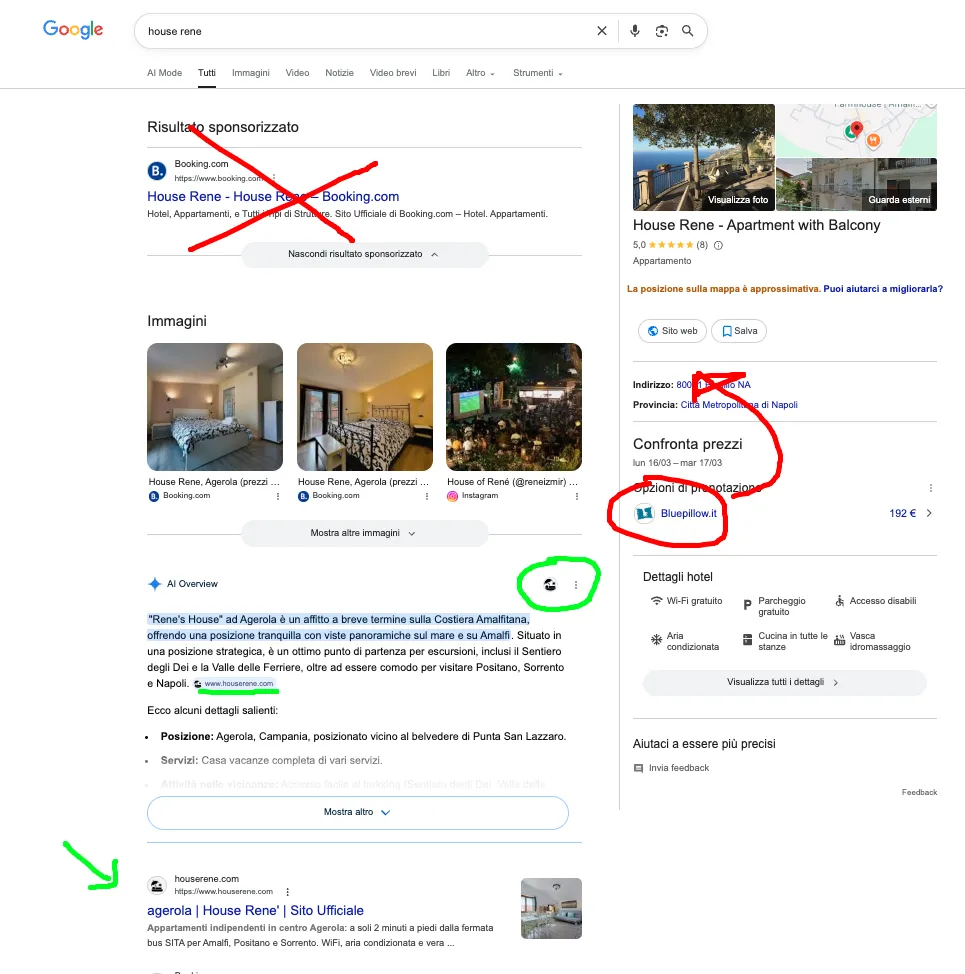
What is happening?
Positive: Artificial intelligence knows who we are and quotes directly from the website. We are first in the list of organic results.
Negative: In the displayed Google Business Profile, the website link in the listing does not lead to the official property website but to an OTA—in this case, via a booking meta-search engine.
Why? Google pulls from its integrated partners (like OTAs), "trusted sources, and structured signals" (These are boring technicalities we’ve already handled for you, trust us: life is better without knowing them!).
How can you tell if this is happening to your property?
Open an incognito tab or private browsing window (very important) and search for your property name on Google. Try changing the search language or location (e.g., if you are in Poland, try searching on google.es or set results for another country). If the Google Business Profile isn’t yours and points to a website that isn’t yours, then you are a victim of this mechanism.
Note: sometimes the phone number and contact details are correctly entered, but the website link or the booking link is not the one leading to your site.
Why it happens: the mechanisms of interception
This phenomenon has multiple cumulative causes. Understanding them is the first step toward countering them. Don’t worry, we won’t be discussing complex concepts that require hours of study. I will guide you step-by-step and case-by-case in a simple, practical way.
Your Google Business name is different from the one on OTAs
This is often the most underestimated issue. Google uses the name on your Google Business Profile as the primary identity signal. If your property is called "Destiny Farmhouse" on Google Business, but appears as "Destiny Farmhouse - Relax & Spa" on Booking.com and "Destiny Country House" on Airbnb, Google struggles to establish with certainty that they are the same entity.
The practical result is that Google might not recognize you as the authority for the property name Destiny Country House. This leaves room for ambiguity that other players can exploit—as they have consistent names across millions of pages—often appearing more relevant to the search than the name on your Google My Business profile.
💡 Golden Rule: The name on your Google Business Profile must be identical—character for character—to the name your property uses on Booking.com, Airbnb, Expedia, and all other OTAs. No additions, no variations, no taglines. Better yet if it’s globally unique!
Missing or incomplete Google Business Profile
Many hosts have never claimed their Google Business Profile, or created one long after adding their Vacation Rental, B&B, or Hotel to various OTAs. In these cases, Google might automatically generate a listing with incomplete information—and anyone, including OTAs, can add data or suggest edits. Your property exists on Google, but you don’t control it.
An unverified profile has less authority in search results. When a user searches for your name, Google lacks a strong signal regarding the legitimate owner of the entity, and OTAs—which are highly verified—fill the void.
Even a verified profile that is thin on information is a problem: without updated photos, an official website link, and the correct category, the website + profile combination loses its strength.
The economic power of OTAs in ad auctions
Major OTAs spend billions of dollars every year on Google Ads. They can afford to bid on every single property name—including yours—because their commission-based model always guarantees a return.
This doesn’t mean you are without options: with a well-made website and an official Google Business Profile, you can effectively dominate the organic section for "branded" searches of your name. Furthermore, when the official profile is correctly linked, the Knowledge Panel reduces the need to chase OTAs on their own advertising turf.
OTA comparators on Google and unofficial listings
In hospitality searches, Google may display comparison modules powered by OTAs and intermediaries who pay to appear. If your property’s official profile is missing or not clearly linked, the user might end up on an OTA link even when they specifically searched for your name.
Essentially, when a strong official presence is missing, Google completes the information using third-party sources, diverting the booking path toward commission-heavy channels.
Official website and branded SEO: this is where you can win
For brand searches (the exact name of your property), a website optimized and consistent with your Google Business Profile can rank very well, often outperforming OTAs in organic results. In this specific area, the technical quality of your site and data consistency matter more than general domain strength.
The situation changes for generic or long-tail queries (e.g., "romantic hotel with spa in..."), which require ongoing active SEO. But that is not the focus of this article: we are talking about reclaiming control of searches for your own name, and in this scenario, the official website + Google Business Profile combo remains your primary leverage.
- Operational guide to creating a website that converts visitors into bookings
The consequences for you, the independent host
Every booking that goes through an OTA instead of your direct channel has a concrete cost. And it’s not just financial.
1. Direct Cost
Average commissions of 15–25% per booking. On a $1,000 week, you pay $150–250 to an intermediary for a customer who already knew who you were.
2. Data Loss
With a direct booking, you get the guest’s email, preferences, and direct contact. With an OTA booking, this information belongs to the platform.
3. Third-party Dependency
OTAs can change algorithms, increase commissions, or penalize your profile at any time. Your visibility is in their hands.
4. Brand Dilution
The guest remembers booking on Booking.com, not with you. The brand relationship with your property weakens with every third-party booking.
Reclaim control: a step-by-step practical guide
Stop the interception of your branded queries and recover the traffic that belongs to you. Here is how.
1. Claim and verify your Google Business Profile
Search for your property on Google and Google Maps. If it doesn’t appear, create it from scratch. If it exists but is not verified (yours), start the verification process (usually via postcard, phone call, or video call with a Google operator).
- ✔ Use the exact official name of the property—no extra keywords
- ✔ Choose the correct category (Hotel, B&B, Vacation Rental, etc.)
- ✔ Enter your direct address, phone number, and website (not OTA links)
- ✔ Upload at least 10 high-quality, up-to-date photos
2. Align names and data across all platforms
This is the most important and most overlooked action. Log in to every OTA you use (Booking.com, Airbnb, Expedia, VRBO, TripAdvisor, etc.) and ensure the name is identical to the one on your Google Business Profile.
If your Google profile says "Villa Serena", every other platform must say exactly "Villa Serena". Not "Villa Serena B&B", not "Villa Serena - Sea View", not "Serena Villa".
3. Claim and correct unofficial or duplicate listings
If you find an unofficial listing, a duplicate, or a listing with incorrect links, take action on the Google Business entry immediately and request a correction or a merge of duplicates.
- → Verify that only one official, claimed, and verified listing exists
- → Use Google Business support to request the correction of erroneous data
- → Ensure the website button always points to your official domain
- → If the name is wrong, update the official name first, then realign OTAs and your site
4. Strengthen the official website + Google Business combo
The key is to make Google understand that you are the official source for your property: the website and Google Business Profile must reinforce each other.
- ✔ On the website: consistent property name, clear contact page.
- ✔ On the Google Business Profile: use the same name and link to your official site to connect the two entities
Take back your business’s digital identity. Check it now!
Frequently Asked Questions
With a Lestis site and an official Google Business Profile, can I appear above OTAs?
Yes. In organic searches for your property name, the combination of a well-built website and a consistent, official Google Business Profile allows for highly competitive positioning, often appearing ahead of OTAs in non-sponsored results.
What is the difference between an official Google listing and an unclaimed one?
An official listing is verified and under your control: name, website, phone, photos, and category. An unclaimed listing may contain incomplete data or third-party links. Claiming it means taking back control of the information Google shows to users.
Do I need to leave OTAs to solve this problem?
No. OTAs can remain a useful channel. The goal is to build a strong direct channel with your website and official Google Business Profile to reduce commissions on searches for your own brand.
How long does it take to see improvements after making corrections?
Major changes can reflect within a few days, while consolidating organic visibility generally takes a few weeks. Consistency across your website, Google Business Profile, and OTAs accelerates the results.
Want a direct website that works for you?
Lestis provides you with a website optimized for branded SEO and an integrated booking engine, while your official Google Business Profile builds trust and local visibility: together, they drive more direct bookings.
Discover Lestis →